9.4.2What is the polar equation for a rose?
Converting Between Polar and Rectilinear Form
For each polar equation below, create a table of values with
CARDIOID:
LIMAÇON:
ROSE:
The cardioid and limaçon you graphed in the previous problem are two of the more interesting curves that can be created using polar equations. Below are some polar equations whose graphs take on a more familiar appearance. Use your graphing calculator to graph each of the polar equations below over the given interval. Then, sketch the graph on polar graph paper and identify the familiar shape.
for
for
for
for
Pilar recognizes the graph from part (a) of problem 9-117 as
If
is same as , then write an equation for in terms of and . Confirm that
geometrically by using the diagram at right. Then, predict how an equation for can be written in terms of and and verify that relationship using the diagram. Write an equation that relates
, , and . Justify your identity using the diagram.
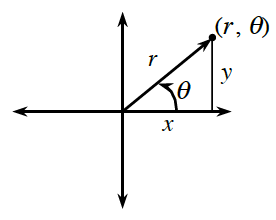
Pilar wants to convert more polar equations into rectangular form and vice versa. Use the identities below to help her rewrite the given equations. Simplify your equations and avoid square roots.

Polar Curves
A polar coordinate is written in the form of
When
A polar curve is composed of all the points (r, θ) for which r = f(θ). That is, r depends on θ. Some special polar curves are shown below.
.png)
.png)
Cardioid
.png)
Limaçon
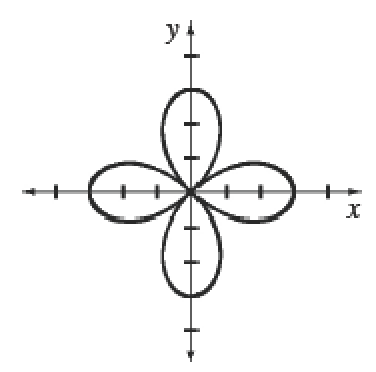
Rose Petal

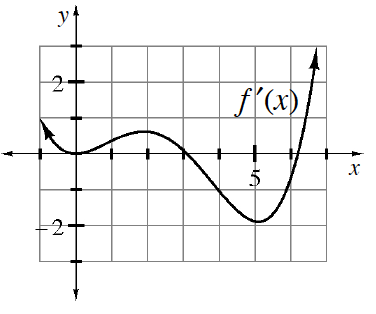
Use the graph of
For what
-value(s) does have a relative minimum? Where does
have points of inflection? Describe what happens on the graph of
when . Describe the graph of
when . If
, estimate .
Solve the differential equation
Thoroughly investigate the graph of
A car is traveling north at
Suppose that
Express
as a function of . Express
as a function of . How will the graph of the parametric equations given above be different if
and ?
On your polar graph paper, complete tables and plot points for
Timmy is tired. He does not want to add the infinite terms of
How far is his result from the actual sum of the infinite series? (This is called his “error.”)
What would his error have been if he added the first four terms?
Generalize his error. That is, if he adds up
terms of this geometric series, what will his error be?